By: Dr. Bentley Lorene Gibson
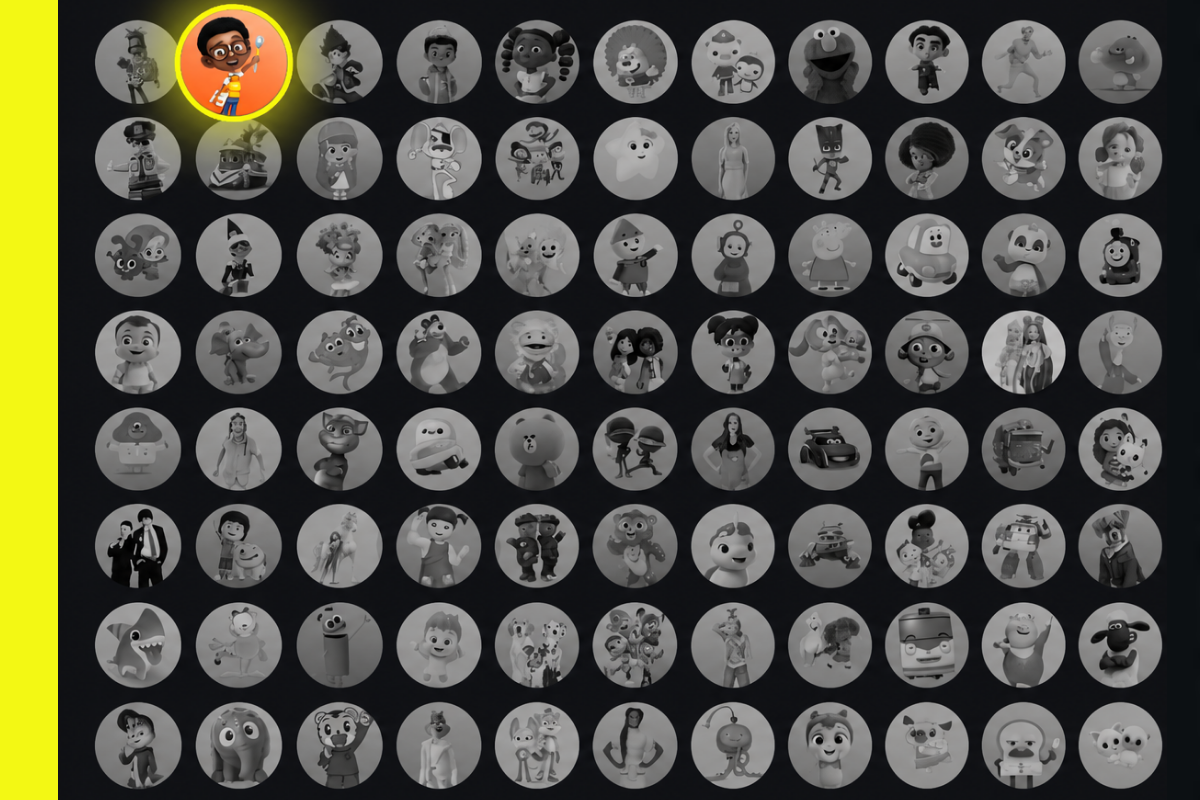
We counted every kids' profile icon in Netflix's character library, the avatars children pick when they open the app.
Out of 112 characters, exactly one is a Black boy.
His name is Ben, from Motown Magic. His story is that he sings and dances.
There are Black girls represented. There are brown skinned boys from Indian animated shows. For Black boys specifically, the count is one character, and the narrative attached to him is entertainment, not science, not medicine, not leadership.
This isn't an accident. It's a design choice, made by people in rooms deciding which shows get greenlit and which characters get built out. Design choices like this one shape the audience your organization is trying to reach, retain, and represent, whether anyone intended that or not.
Why this is a business problem, not just a representation problem
If your organization builds or distributes content, media, streaming, publishing, or marketing, the characters, spokespeople, and stories you put in front of an audience are a decision. It gets made the same way a hiring panel or a promotion committee makes a decision, under time pressure, with incomplete visibility into whose default assumptions are actually driving the call. The Netflix icon library is a visible, countable example of what happens when that decision gets made without a measurement step built in. Most of the time, the outcome stays invisible until someone actually sits down and counts.
Why this shows up so early
This isn't only a professional observation. It's the subject of my own published research. I studied the early development of racial attitudes in young children and found that white bias is evident in preschool-aged children across multiple races and ethnicities, in the U.S. and internationally. European American preschoolers who identify with a white doll also prefer it over a Black doll. African American children who identify with a Black doll show no significant preference for it over a white doll. We found a comparable, if not stronger, white preference bias in Polynesian and Melanesian children tested in their home countries, and in second generation Indian American children (Gibson, Robbins, and Rochat, 2015, Journal of Cognition and Culture).
Children are sensitive to signals of social status by preschool age, and across cultures, status still tends to get associated with lighter skin. The content children consume isn't neutral. It actively shapes which faces they associate with value, authority, and possibility. A kids' profile screen where the only Black boy sings and dances reinforces the exact bias my research documents forming in three-year-olds.
What changes when representation is designed on purpose
The upside case is just as measurable as the downside. Johns Hopkins economists tracked over 100,000 Black students and found that a single Black teacher in elementary school changed life trajectories:
Outcome
29% less likely to drop out
Dropout risk falls 39%
13% more likely to enroll in college
32% more likely to enroll in college
Exposure
One Black teacher, grades 3 to 5
Same, for low income Black boys specifically
One Black teacher by third grade
Two Black teachers by third grade
(Gershenson et al., 2018, NBER; Johns Hopkins Hub, 2017)
The effect isn't limited to the students who share the teacher's race. In a randomized study, researcher David Blazar found Black teachers improved test scores and cut absences by over 20 percent for all students, with gains that persisted into high school, driven by measurably stronger classroom practices, not identity alone (Blazar, 2021, Annenberg Institute). Representation, done on purpose, is infrastructure. It isn't sentiment.
The takeaway for media and content organizations
Netflix's profile icon library, the shows that get greenlit, the characters that get developed- these are all decisions made by people under deadline. That's the same category of high-stakes, repeatable decisions The Bias Adjuster is built to measure and improve. When bias in those decisions is invisible, it's uncorrectable. Once it's counted, it becomes fixable.
If your organization is making content, casting, or brand representation decisions at scale, this is exactly the kind of exposure our Marketing and Media Specialist Training is built to surface, before an audit like this one happens to your platform instead of someone else's.
References
Gibson, B., Robbins, E., and Rochat, P. (2015). White Bias in 3 to 7 Year Old Children across Cultures. Journal of Cognition and Culture, 15(3 to 4), 344 to 373. Gershenson, S., Hart, C., Hyman, J., Lindsay, C., and Papageorge, N. W. (2018). The Long Run Impacts of Same Race Teachers. NBER Working Paper No. 25254. Johns Hopkins University Hub (2017). Black students who have at least one Black teacher are more likely to graduate. Blazar, D. (2021). Teachers of Color, Culturally Responsive Teaching, and Student Outcomes. Annenberg Institute at Brown University, EdWorkingPaper 21-501.
About the author: Dr. Bentley Gibson, PhD, is a cognitive and developmental psychologist specializing in implicit bias, and the founder of The Bias Adjuster. Her published research includes studies on the early development of racial bias in children (Journal of Cognition and Culture).